The Role of Certificates of Destruction in Enterprise Risk Management
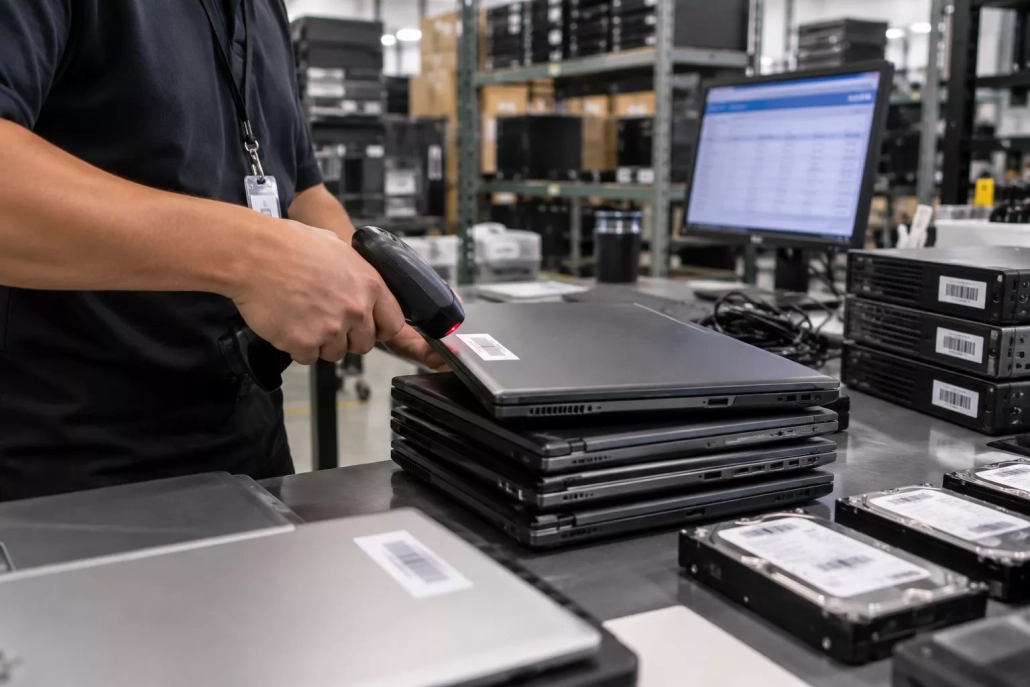
Every retired laptop, server, and storage device leaves your organization carrying residual data and unresolved liability. Certificates of Destruction turn that quiet risk into documented, defensible evidence you can present during any audit. Enterprise risk teams now treat these certificates as core governance artifacts rather than paperwork.
Regulators, auditors, and cyber insurers increasingly ask the same question about retired assets. You need to prove exactly what happened to each data-bearing device and when. Without that proof, your risk exposure grows with every disposal cycle.
What Role Do Certificates of Destruction Play in Enterprise Risk Management?
Certificates of Destruction serve as legal evidence that data-bearing devices were rendered unreadable using verified sanitization or physical destruction methods. They give risk officers, auditors, and regulators a defensible record tied to each serial number and disposition event. As a result, enterprises reduce breach exposure, audit findings, and downstream litigation risk across every location.
Why Certificates of Destruction Matter to Enterprise Risk Officers
Retired hardware often carries the same sensitive records as active systems, yet controls around it weaken quickly. Consequently, risk officers face growing pressure to prove that end-of-life devices were sanitized or destroyed. Certificates of Destruction give them the documented evidence that policies were followed in the field.
According to the Verizon 2025 Data Breach Investigations Report, third-party involvement in breaches doubled to 30% of confirmed incidents. Therefore, vendor-issued documentation now sits at the center of enterprise risk conversations. Boards want assurance that disposal partners are held to verifiable standards.
Insurance underwriters also request disposal evidence during cybersecurity policy renewals and claims reviews. Missing records can weaken coverage terms, delay claims, or increase premiums. Explore how secure data destruction supports insurer and auditor expectations.
What a Defensible Destruction Record Should Contain
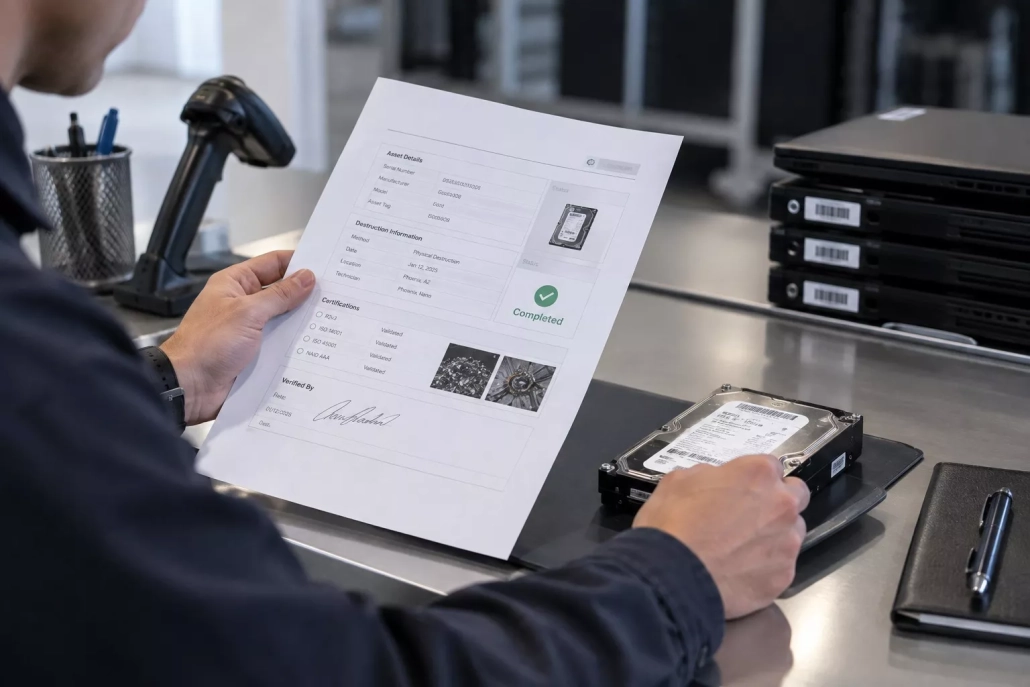
A defensible certificate goes far beyond a signature and date on company letterhead. It ties each retired device to a verified sanitization method and a documented chain of custody. Additionally, the format should support easy retrieval during audits, incident response, or legal discovery.
Enterprise risk teams should require Certificates of Destruction that include specific data points at the serial-number level. In practice, the following fields make a certificate audit-ready and legally defensible.
- Unique device identifiers: Serial numbers, asset tags, manufacturer, and model for every processed item
- Sanitization method: Wiping standard applied or physical destruction technique used
- Date and location: When and where destruction occurred, including facility identifiers
- Certified operator: Name and credentials of the technician performing the work
- Vendor certifications: R2v3, ISO, and NAID references validating process integrity
- Witness or verification: Signatures or digital validation confirming the completed event
Standardized certificates also make it easier to reconcile records across dozens of sites during quarterly reviews. Review our guidance on audit-ready ITAD documentation for detailed formatting best practices.
Regulatory Frameworks That Demand Documented Proof
Multiple regulations expect documented proof of destruction for records containing sensitive personal, financial, or health information. Consequently, Certificates of Destruction have become a shared requirement across healthcare, finance, education, and government sectors. Missing documentation can quickly convert a routine operational task into a serious regulatory reporting event.
According to HHS Office for Civil Rights (OCR) enforcement data, OCR has resolved 152 cases with penalties totaling $144.8 million. Many of those cases involved failures in safeguarding or documenting the handling of protected data. Similarly, HIPAA, GLBA, FACTA, SOX, and state privacy laws expect verifiable destruction evidence.
Auditors reviewing SOC 2, ISO 27001, or PCI DSS programs also expect certificates tied to individual assets. Cross-border operations must also satisfy GDPR requirements around lawful erasure of personal data. Certificates of Destruction provide a single artifact that supports each of these frameworks.
Enterprise risk officers should therefore align their disposal policies with the strictest applicable standard. Learn how ITAD services can standardize destruction records across every regulated environment.
How to Embed Destruction Documentation Into Daily Governance
Documentation only reduces risk when it is embedded into repeatable workflows rather than treated as an afterthought. Otherwise, certificates end up scattered across email threads, shared drives, and vendor portals. A structured governance approach makes retrieval fast and audit responses defensible.

Your governance model should tie every disposal event to a Certificates of Destruction record stored in a centralized repository. Additionally, service-level agreements with disposal partners must define certificate content, delivery timing, and retention format.
- Central repository: Store all destruction records in a searchable, access-controlled system
- Serialized tracking: Match each certificate to inventory records at the device level
- Retention schedule: Align certificate storage with the longest applicable regulatory retention period
- Quarterly reconciliation: Confirm every retired device has matching destruction evidence
- Vendor scorecards: Rate disposal partners on documentation quality, timeliness, and completeness
Reconciling inventory to certificates each quarter surfaces missing records before auditors do. Read more about aligning disposition with regulatory standards to strengthen your operational workflow.
Strengthen Enterprise Risk Programs With Verified Destruction Records
Enterprise risk management now depends on evidence that stands up under regulatory, audit, and insurance scrutiny. Certificates of Destruction turn end-of-life technology into documented, defensible outcomes rather than open exposure. Strong records protect your organization long after retired hardware leaves your facilities.
RAKI delivers audit-ready Certificates of Destruction backed by R2v3, ISO-certified processes, and nationwide operational coverage. Our team supports enterprise risk officers with serialized reporting, verified sanitization methods, and centralized documentation. To bring governance-grade destruction records into your risk program, contact our team today.


Leave a Reply
Want to join the discussion?Feel free to contribute!