Secure Chain of Custody: Why Documentation Matters in IT Asset Disposition

Every retired laptop, server, or drive passes through many hands before final destruction or resale. A secure chain of custody turns that journey into documented evidence you can defend during any audit or investigation. Without it, your organization inherits every gap between pickup and final disposition.
Regulators, insurers, and legal counsel now expect verifiable custody records tied to each serial number. Missing signatures, unlabeled containers, or unexplained delays quickly become material findings during compliance reviews. Strong documentation transforms disposal from an assumption into evidence.
Why Does Chain of Custody Documentation Matter in IT Asset Disposition?
Chain of custody documentation proves that every data-bearing device stayed under controlled handling from pickup through final disposition. It captures time-stamped handoffs, personnel identifiers, transport details, and destruction outcomes for each serialized asset. As a result, your organization gains defensible evidence that satisfies auditors, regulators, insurers, and internal risk teams.
Why Chain of Custody Sits at the Center of IT Asset Disposition
Retired devices often contain the same sensitive records they held during active service. Consequently, every handoff between staff, movers, drivers, and processors creates a new opportunity for exposure. A documented chain of custody closes those gaps with verifiable evidence at each step.
According to the 2026 Cost of Insider Risks Global Report by Ponemon Institute, employee negligence caused 53% of insider incidents. Additionally, the average annual cost to remediate those incidents reached $10.3 million per organization. Weak custody controls magnify that exposure across every retirement cycle.
Custody records also protect you during litigation, insurance claims, and regulatory investigations. Therefore, defensible documentation reduces the cost of proving due care after the fact. Learn how secure data destruction reinforces custody discipline from pickup through destruction.
Core Elements Every Custody Record Should Capture
A defensible custody record goes far beyond a driver signature on a bill of lading. It ties each serialized device to a documented sequence of handoffs, personnel, and physical controls. Additionally, the format should support fast retrieval during audits, incident response, or legal discovery.

Your chain of custody documentation should capture specific data points at every stage of the disposal workflow. In practice, the following elements make custody records audit-ready and legally defensible.
- Serial-level tracking: Unique identifiers, asset tags, and manufacturer details for every device
- Time-stamped handoffs: Date, time, and named personnel for each transfer of possession
- Container controls: Seal numbers, tamper-evident locks, and container identifiers
- Transport details: Vehicle identifiers, driver credentials, and route documentation
- Exception notes: Documented anomalies, delays, or discrepancies discovered along the way
- Final disposition: Sanitization or destruction method tied to each serial number
Standardized fields also make it easier to reconcile custody records against inventory and destruction certificates. Review our guidance on audit-ready ITAD documentation for detailed formatting best practices.
How Certifications Reinforce a Secure Chain of Custody
Certifications give you third-party validation that your ITAD partner enforces custody standards under audit conditions. Consequently, they reduce vendor risk and simplify documentation reviews for your compliance team. Not all certifications carry the same weight, so contract language should specify which ones apply.
According to SERI R2v3 certification standards, R2v3 certified providers must document chain of custody from collection through final disposition, including downstream vendor oversight. Similarly, ISO 9001, ISO 14001, and ISO 45001 add quality, environmental, and occupational safety controls that reinforce custody discipline at every handoff. Together, these standards give you independently verified evidence of custody integrity across the full disposal lifecycle.
Certification also reduces the burden of vendor due diligence during onboarding and renewal cycles. As a result, compliance teams can focus review time on service delivery rather than baseline security controls. Contracts should require current certification documentation and audit reports on request.
Layered certifications strengthen your defensible position across HIPAA, GLBA, FACTA, SOX, and GDPR frameworks. Explore how about RAKI supports enterprise programs with layered certification coverage.
Common Chain of Custody Failures and How to Prevent Them
Most custody failures follow familiar patterns that appear across industries and disposal partners. Otherwise strong programs falter when documentation is inconsistent, incomplete, or scattered across systems. A structured approach closes the most common gaps before they surface in audits.
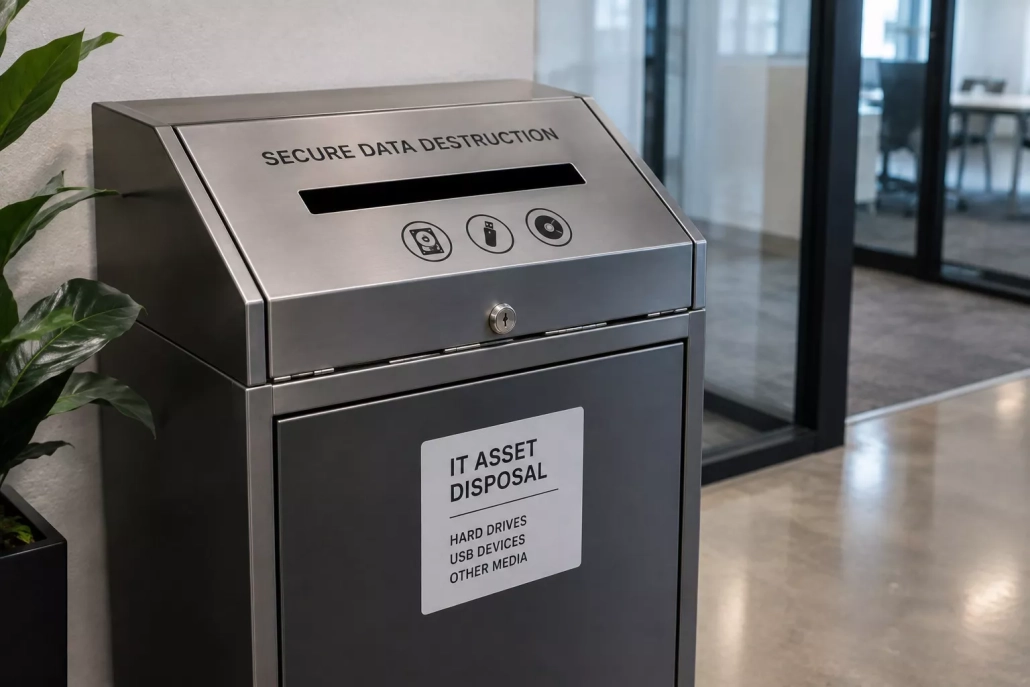
Your team should watch for specific warning signs during pickup, transport, and processing. Additionally, contract language and vendor scorecards should hold partners accountable for each control point.
- Incomplete manifests: Missing serial numbers, quantities, or descriptions on pickup paperwork
- Unlabeled containers: Sealed totes or pallets without unique identifiers tied to inventory
- Open staging areas: Retired devices left in unsecured spaces before scheduled pickup
- Generic receipts: Documentation that does not map to specific serialized assets
- Delayed reporting: Long gaps between pickup and delivery of custody or destruction records
Closing these gaps requires shared standards between your team, your ITAD partner, and any downstream vendors. Read more about standardized IT asset reporting to see how consistent formats reduce audit friction.
Strengthen Your ITAD Program With Verified Custody Records
Chain of custody documentation now sits at the heart of every defensible IT asset disposition program. Verified custody records reduce breach exposure, satisfy auditors, and protect your organization during any investigation. Discipline at every handoff produces documentation that stands up to regulatory and insurance scrutiny.
RAKI supports enterprise ITAD programs with R2v3 certified processes, ISO-aligned controls, serialized custody tracking, and nationwide operational coverage. Our team delivers documented handoffs, audit-ready reporting, and Certificates of Destruction tied to every retired device. To bring verified chain of custody discipline into your disposal program, reach our team today.

Leave a Reply
Want to join the discussion?Feel free to contribute!